

 Tours
 Soft Adventure
 Stargaze
 Dark Sky Astro Experience
 Snowshoe
 Hiking
 Fishing
 Photography
 Activities
 Food and Drink Tours
 Weddings
 Groups
 RMNP Webcam
 Dark Sky Hub
Your First Night Stargazing in Rocky Mountain National Park
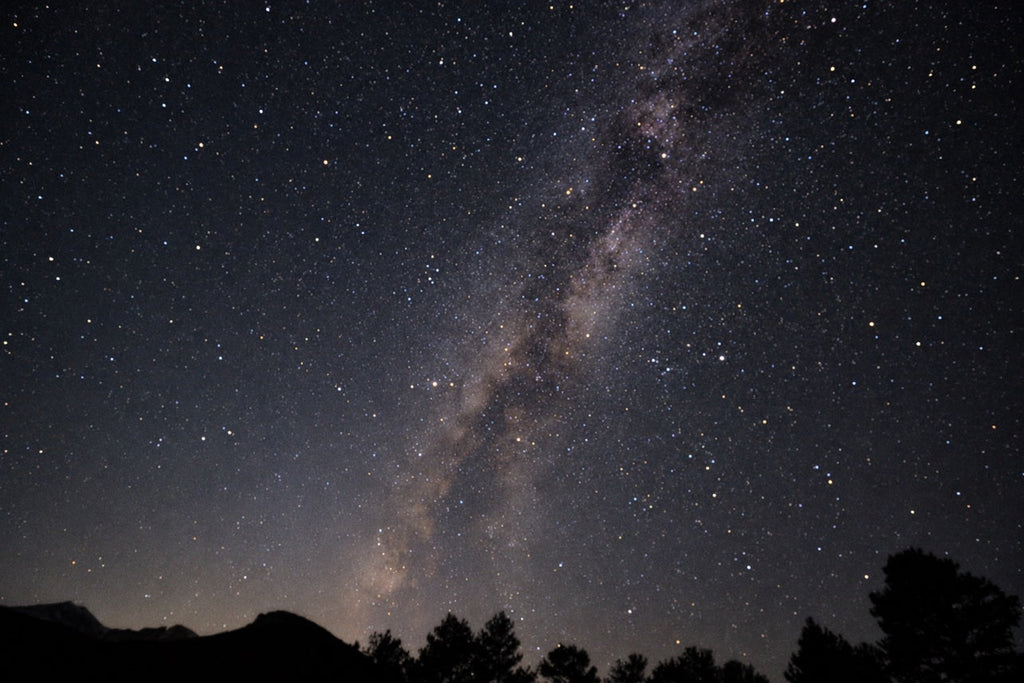
Your first night stargazing in Rocky Mountain National Park will probably surprise you, and not because of one big moment. It is the slow build that gets people: the sky darkening in stages, the stars arriving in waves, and then the Milky Way showing up like it was there all along. Here is how a first night usually goes.
Arrive before dark
Pick your spot in daylight. Drive in while you can still see, park, and walk the ground you will stand on later. A meadow pullout or a lake parking lot is enough. You are not hiking in the dark on a first night, and you do not need to. Set out a blanket or a camp chair, lay out your layers, and put your red flashlight where you can find it without turning on a white light.
Dress warmer than the daytime temperature suggests. Even in July and August, the temperature drops fast once the sun is gone, and standing still under a clear sky cools you quicker than walking does. Layers, a hat, gloves, and warm boots are the difference between staying two hours and leaving after twenty minutes.
Rocky Mountain National Park is open 24 hours a day. In the summer season, timed entry reservations apply only in the daytime (9 a.m. to 2 p.m. for most of the park, 5 a.m. to 6 p.m. for the Bear Lake Road corridor in 2026), so an evening visit needs a park pass but no timed entry reservation. The park has not yet published its 2027 timed entry dates, so check the Park Service page before a summer trip.
The first hour: dusk and the first stars
The sun sets behind the Continental Divide, and the western sky holds color for a long time after. This is the time to settle in and let your eyes start adjusting. The first star to appear is usually a planet, often Venus low in the west, shining steady and bright while the real stars are still hidden. Planets do not twinkle the way stars do, which is the easiest way to tell them apart.
As the blue fades to black, the brightest stars come out one at a time. Give your eyes twenty minutes in the dark before you decide what you can and cannot see. Full night vision takes that long, and one look at a bright phone screen resets the clock for everyone nearby. Keep screens dim and use only red light once you are out.
The second hour: the sky fills in
This is when the night earns its reputation. The fainter stars arrive in the hundreds, then the thousands, and the constellations stop being connect-the-dots and start looking like the pictures in a book. Cassiopeia makes its W shape, and in winter Orion climbs in the east.
Then the Milky Way appears. It does not switch on. It builds slowly as your eyes adapt, a soft, cloudy river of light running across the sky. To the naked eye it looks grayish white, not the colorful swirl in photographs. That is normal, and it is the real thing.
What you will actually see
Set expectations honestly and the night will not disappoint you. You will see the Milky Way as a soft band on a moonless night. You will see planets as steady points of light. You will see meteors as quick streaks, a few per hour on an ordinary night and far more during a shower. You will see satellites drifting silently overhead, brighter than most people expect.
Through binoculars the Moon shows craters and Jupiter shows its moons, but you do not need any of that on a first night. Naked eye stargazing under a dark sky is rich on its own. Our comparison of eyes, binoculars, and telescopes explains what each option shows: https://estesparktourguides.com/blogs/news/eyes-binoculars-telescopes-stargazing-compared
The Milky Way
The bright core of the Milky Way is a seasonal sight, above the horizon at night from roughly March through October and at its best from June through August. Go in the week around the new moon, when the sky is at its darkest. When to go, including moonlight and seasons, is covered in depth here: https://estesparktourguides.com/blogs/news/when-to-go-stargazing-estes-park
When to call it a night
Go on your own or with a guide
Going on your own is simple: a dark spot, a clear moonless night, and warm layers. If you would rather have someone else pick the spot, read the sky, and bring the telescope, our guided Stargaze tour runs on clear nights in Rocky Mountain National Park: https://estesparktourguides.com/products/hikebyheadlamp
Quick answers
Where is the best place to stargaze in Rocky Mountain National Park? Moraine Park for the widest horizon, Sprague Lake for the easiest walk, Horseshoe Park for drive-up access, and Cub Lake for a quiet hike-in night. Full detail is in our spots guide: https://estesparktourguides.com/blogs/news/best-stargazing-spots-rocky-mountain-national-park
When is the best time for a first night? A clear night in the week around the new moon, after the sky is fully dark.
Go with a guide
If you would rather go with someone who knows the trails, the sky, and the seasons, our guides lead trips in Rocky Mountain National Park and around Estes Park every day. See the guided tours and pick the one that fits your trip.
-
Posted in
Stargazing and Night Sky